



Aso Oke Gown Styles You Can Order From Your Tailor
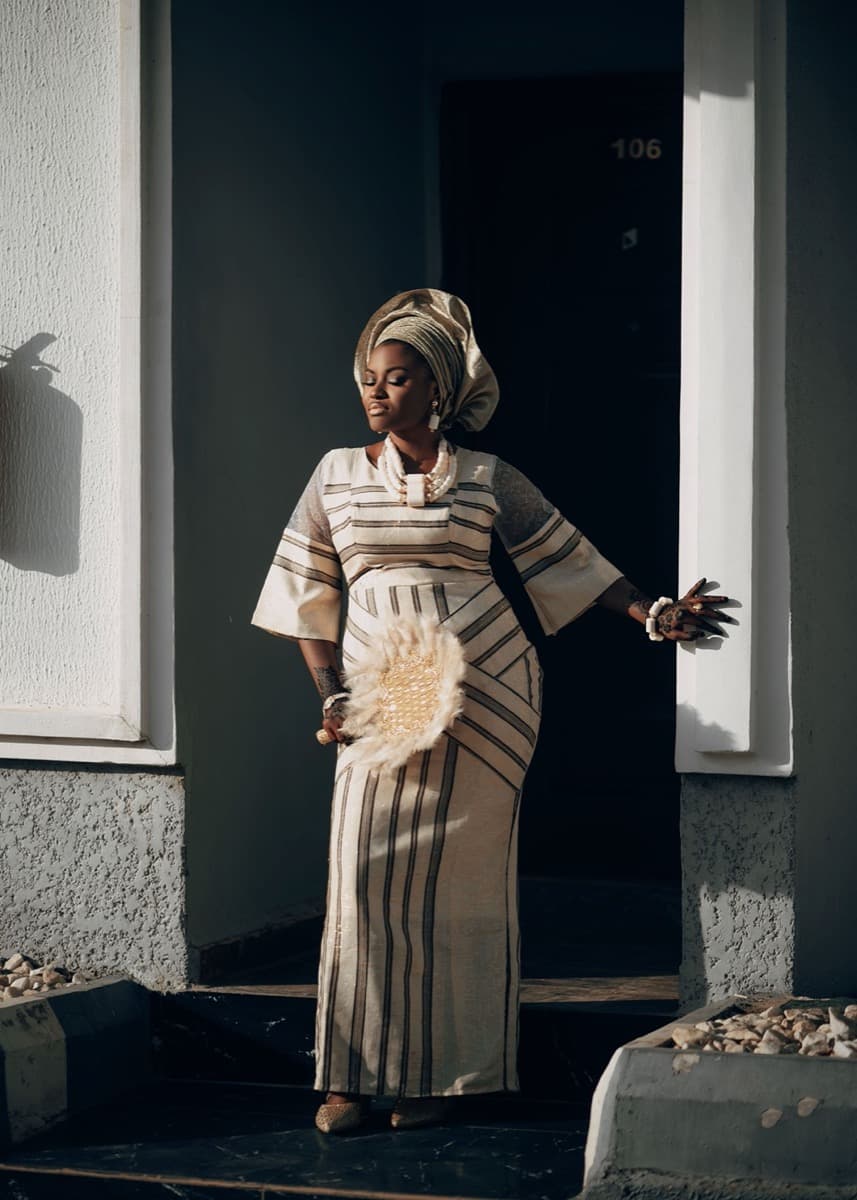
A fitted aso oke gown isn't cut from a single piece of cloth the way a lace or ankara gown is — it's built from narrow handwoven strips, hand-stitched together into panels first. That's not a minor technical detail: it's the reason a structured aso oke gown takes more skill to get right than most other fabrics, and why it's worth understanding before you ask a tailor for one.
If you've seen a corseted, fitted aso oke gown and want one made, here's what's actually involved.
How a Fitted Gown Gets Made From Strip-Woven Cloth
Aso oke comes off the loom as narrow strips — roughly 10 to 15cm wide — which weavers hand-stitch edge to edge into wider panels with near-invisible seams. A traditional loose wrapper (iro) can take up to 22 of these strips pieced together. A fitted gown asks more of the fabric: instead of draping loose strip-panels around the body, a tailor has to cut and shape them into a silhouette that actually follows your waist and hips.
This is genuinely harder than it sounds. Aso oke frays easily once cut, and one academic study of Nigerian tailors found that many working with the fabric lack specific training in joining and cutting it without fraying, and that it doesn't naturally drape the way a fluid fabric does — the coarser weave resists the kind of soft shaping a lace or chiffon gown takes for granted. Well-constructed pieces from tailors who know the fabric get around this; poorly-cut ones show it immediately. This is the single biggest reason to go to a tailor who's specifically worked with aso oke before, not just any tailor who does gowns.
Designers Who've Proven It Works
The clearest proof that aso oke can be built into a genuinely structured, corseted gown is Deola Sagoe's Komole line — pieces like an ivory boned corset with a winged skirt, and raspberry corsets with floral A-line skirts. Sagoe's team spent years developing "komole" fabric, aso oke woven through with silk specifically to make the traditionally coarse texture more wearable in a fitted, floor-length silhouette. It's a real example of what's possible, though it also underlines that raw, standard aso oke wasn't originally built for tight corsetry — getting there took real fabric engineering, not just clever cutting.
Kenneth Ize is the other major name worth knowing — he runs his own aso oke weaving operation in Ilorin and has taken the fabric to Paris Fashion Week in sharply tailored, structured pieces, though his focus leans more toward tailored suiting than corseted gowns specifically. Emmy Kasbit has also used aso oke panels as structural accents (like a cummerbund) on tailored silhouettes, rather than building whole gowns from it.
None of this means you need designer-level budget to get a good fitted aso oke piece — it means the fabric rewards a tailor who's actually handled it before over one who hasn't.
What to Budget
Aso oke fabric itself runs roughly ₦5,000-₦30,000 per yard in Lagos for standard weaves, up to ₦15,000-₦40,000 per yard for wedding-grade weaves. On top of the fabric, tailoring a structured or beaded aso oke gown typically costs more than a simple iro-and-buba — budget closer to the higher end of what your tailor quotes for detailed, fitted work, since the cutting and piecing genuinely takes longer than a straightforward wrapper style.
A commonly cited rule of thumb is that a full gown needs around two bundles of aso oke (roughly 16 strips) rather than the single bundle a simpler style might use — but confirm this with your specific tailor and style, since it varies with how fitted the cut is and how much is pieced versus draped.
Questions to Ask Your Tailor Before You Order
A few things are worth asking upfront rather than assuming:
- Has this tailor worked with aso oke in a fitted cut before? Given how differently it behaves from lace or ankara, this matters more than general tailoring skill.
- Will the gown be lined? Aso oke's texture is coarser against the skin than most fabrics, and lining also helps the fabric hold a fitted shape — but there's no single standard answer, so ask what they recommend for your specific style.
- If you want boning or a corseted bodice, ask directly how they plan to construct it — whether over a lining, with interfacing, or another method. This is exactly the kind of detail worth confirming before cutting starts, not after.
- How much lead time do they need? Aso oke gowns generally take longer than fabrics that don't require this much piecing and careful cutting — ask for a realistic timeline rather than assuming it matches a standard gown order.
Caring for the Finished Gown
Once it's made, aso oke needs the same gentle handling regardless of the cut — hand-wash cold with a mild detergent, air-dry in the shade, and store away from direct sunlight. The full care rundown (plus the fabric's history, classic types, and other ways to style it) is in our complete aso oke guide.